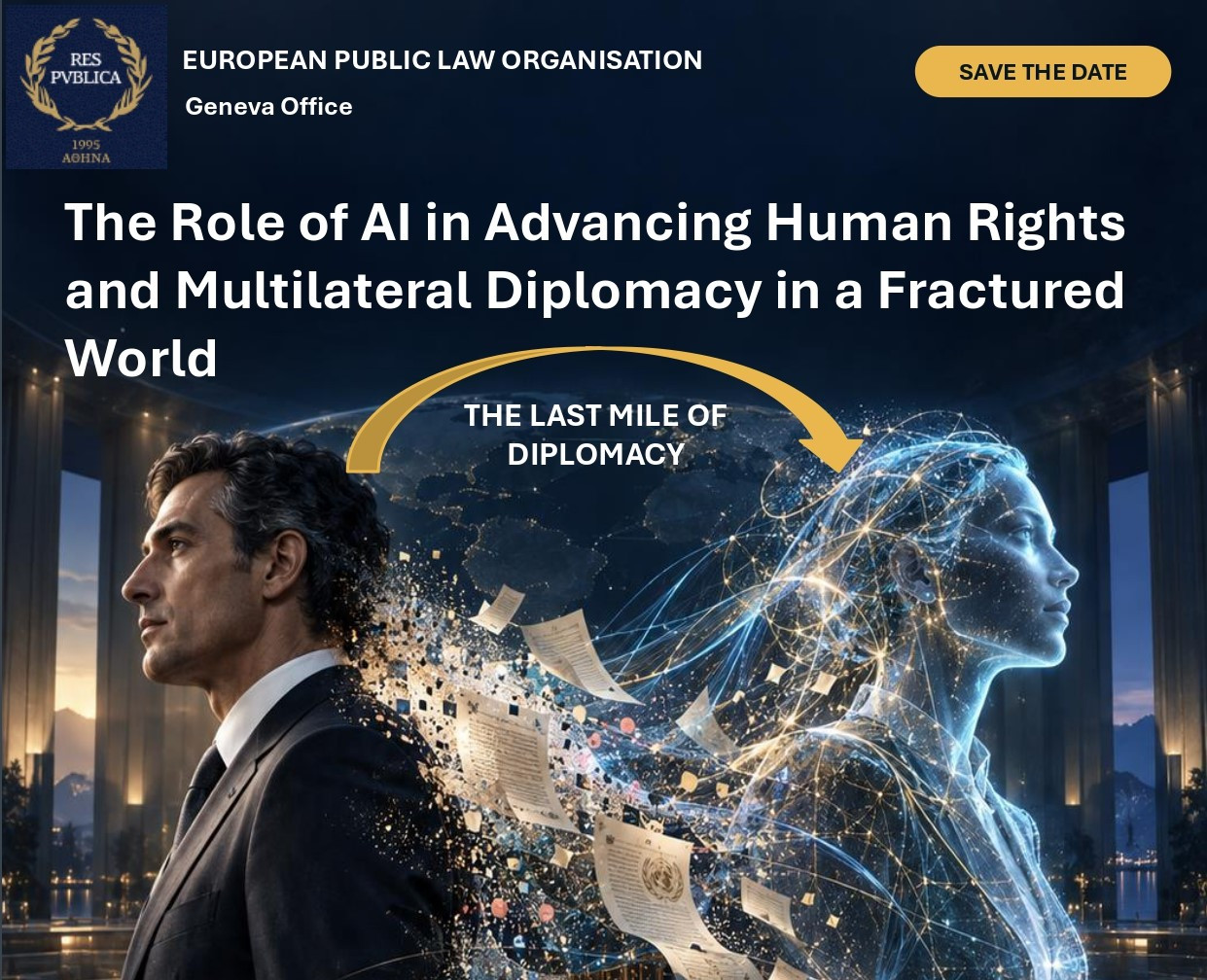
EPLO convenes high-level discussion at the 63rd session of the UN Human Rights Council in Geneva
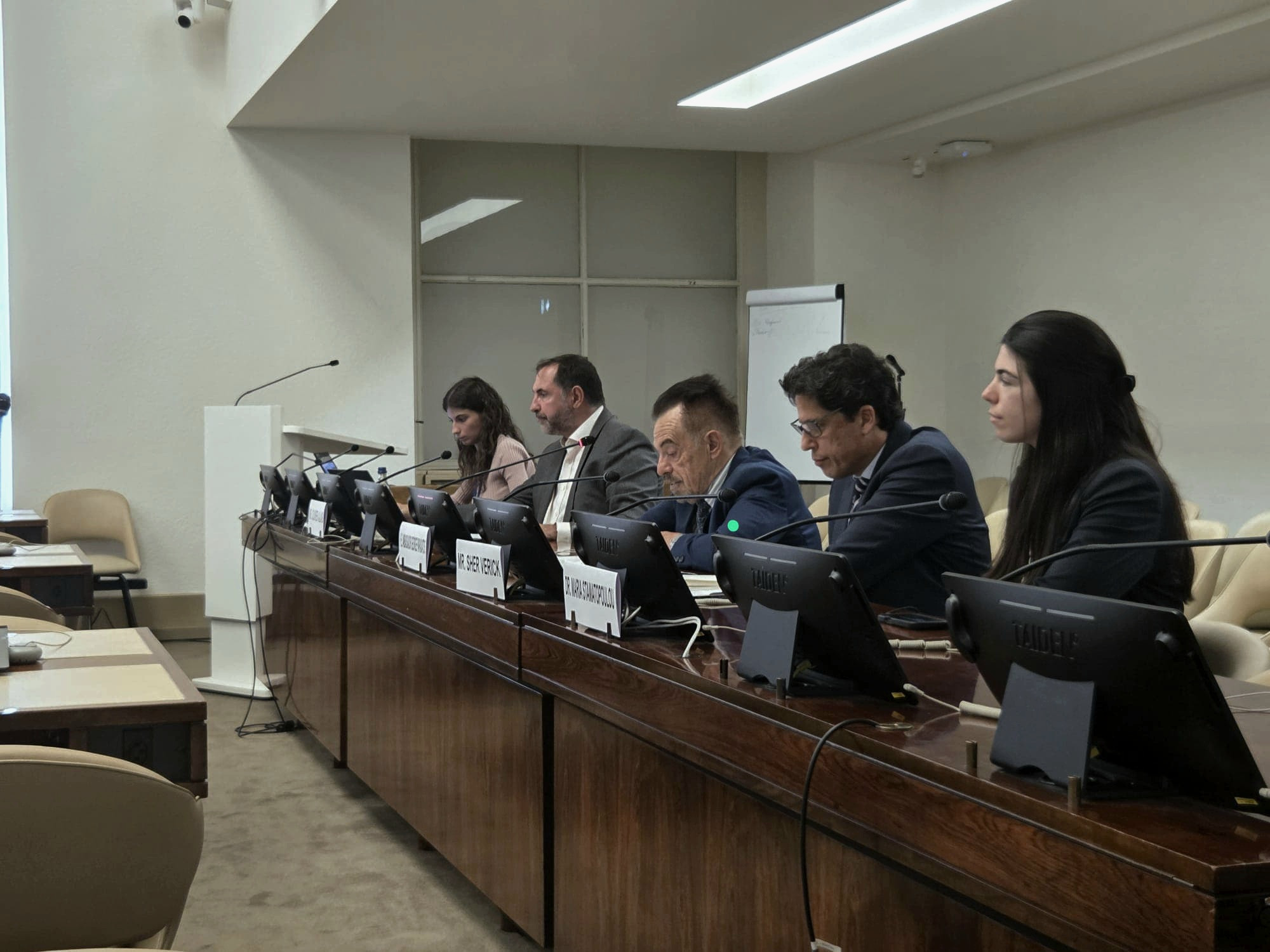
On 28 September 2026, the European Public Law Organization (EPLO) convened a side event at the Palais des Nations in Geneva exploring the potential role of artificial intelligence in advancing human-rights-based multilateral diplomacy.
Held during the 63rd session of the United Nations Human Rights Council, the event, “The Role of AI in Advancing Human Rights and Multilateral Diplomacy,” brought together experts from diplomacy, international organizations, technical standardization and the private technology sector to examine how AI could support international negotiations at a time of growing geopolitical fragmentation and pressure on the multilateral system.
The discussion was moderated by H.E. Ambassador George Papadatos, Permanent Observer of the EPLO to the United Nations and other international organizations in Geneva, with contributions from Mr. Sher Singh Verick, Coordinator for Digitalization and AI at the International Labour Organization (ILO); Mr. Olivier Alais, Programme Coordinator at the Telecommunication Standardization Bureau of the International Telecommunication Union (ITU); and Dr. Maria Stamatopoulou, Co-founder and Chief Research Officer of Laelaps AI.
Exploring the “last mile” of diplomacy
Opening the discussion, Ambassador Papadatos introduced the concept of the “last mile of diplomacy”, an approach to exploring whether AI could help reopen the search for solutions when conventional diplomatic negotiations have reached an impasse.
Under the proposed model, parties would first establish the applicable legal and human-rights framework, together with their political red lines, security requirements, humanitarian priorities and acceptable risks. AI could then be used to map this complex negotiating space, identify trade-offs, test scenarios and generate potential configurations for consideration by human negotiators.
The objective, Ambassador Papadatos emphasized, would not be to automate diplomacy or delegate political decisions to a machine. Rather, AI could expand the range of possibilities available to negotiators while legitimacy, accountability and final decision-making remain firmly in human hands.
AI as a tool, not a substitute for human judgment
Across the panel, speakers agreed that AI has considerable potential as an analytical tool, particularly in processing large volumes of information, comparing complex positions, identifying inconsistencies and modelling possible outcomes.
Mr. Verick placed the discussion within the ILO’s experience of social dialogue and human-centred approaches to technological change. He highlighted the importance of participation, transparency and clear accountability in the use of AI, as well as the need to address risks including bias and discrimination.
Mr. Alais examined the issue from the perspective of international technical standardization, stressing that technical standards increasingly function as a form of governance. He emphasized the importance of developing transparent multilateral standards and ensuring that public-interest and human-rights safeguards do not depend solely on private contracts or corporate discretion. He also drew attention to inequalities in access to computing capacity, technical expertise and standard-setting processes.
Dr. Stamatopoulou focused on what AI can, and cannot, contribute to complex negotiations. AI can rapidly search extensive sets of variables, perform consistency checks, estimate consequences and identify combinations that human teams may not immediately consider. However, she stressed that AI cannot determine which values matter, create political legitimacy or assume responsibility for an outcome.
A central theme emerging from the discussion was therefore the importance of problem specification. Before an AI system is used, negotiators must determine the objectives, constraints, legal obligations and priorities against which possible solutions will be assessed. Human rights and international law must form part of that framework from the outset rather than being treated as variables to be balanced after the fact.
Human diplomacy remains indispensable
The discussion with participants explored some of the most pressing questions surrounding the use of AI in international affairs, including bias, hallucinations, accountability and the danger of placing undue confidence in apparently authoritative AI-generated results.
Participants also highlighted dimensions of diplomacy that cannot easily be captured by computational systems: personal relationships, informal conversations, political intuition, trust and tacit knowledge.
Speakers consequently emphasized that AI should complement human expertise rather than replace it. AI-generated analysis must remain subject to expert scrutiny and verification, particularly when it is used in areas involving fundamental rights, international law, security and political decision-making.
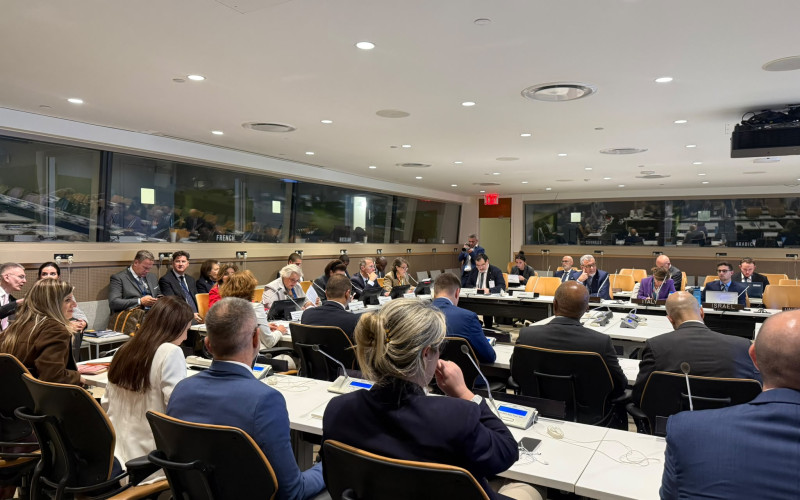
The approximately 50 participants included representatives of delegations from Albania, Belgium, Estonia, Finland, France, Hungary, Maldives, Mozambique, Oman, Poland and Zimbabwe, alongside representatives of the Council of Europe, civil society, students and members of the international community in Geneva.
Opening new possibilities for multilateralism
The event concluded that AI could offer valuable new tools for multilateral diplomacy, particularly by helping negotiators examine complex information and discover possibilities beyond established negotiating positions. At the same time, its use must be accompanied by clear legal and institutional safeguards, meaningful human oversight, independent scrutiny and greater international cooperation on standards.
EPLO’s proposed “last-mile” approach offers a starting point for further interdisciplinary discussion: not diplomacy conducted by machines, but technology used to create new possibilities for human diplomacy.
By bringing together diplomatic, legal, labour, technical and technological perspectives, the event underscored the need for continued dialogue on how emerging technologies can serve multilateral cooperation while preserving the centrality of human rights, public accountability and human judgment.