
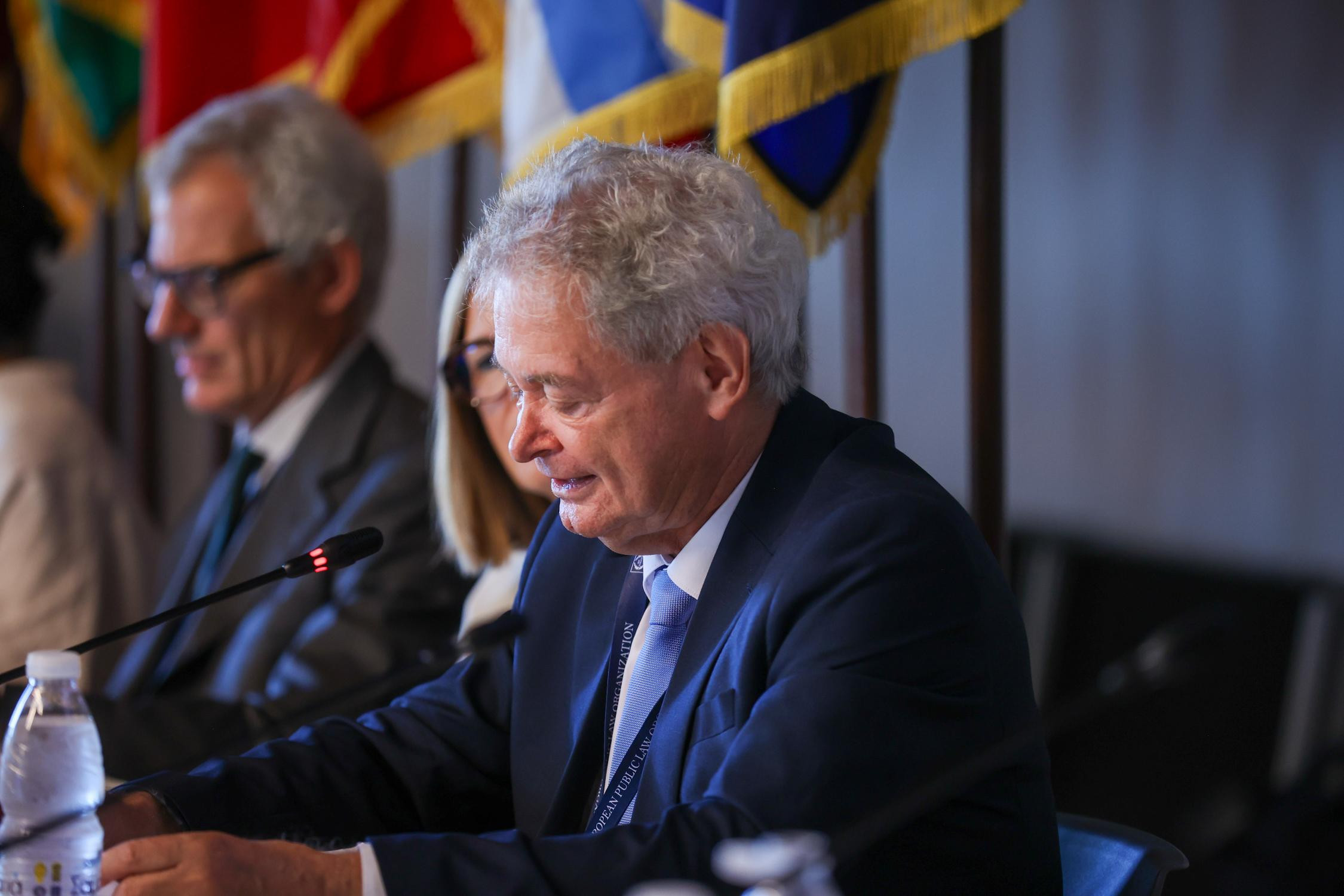
The European Group of Public Law (EGPL), one of the founding pillars of the European Public Law Organization (EPLO), brings together distinguished jurists, academics, judges, diplomats, public officials and policymakers from across the world to advance dialogue on public law, democracy, governance, and the rule of law. Each year, its Annual Reunion provides a unique forum for the exchange of ideas on the most pressing legal, political and institutional challenges facing the international community.
Following the conclusion of the 2026 Annual Reunion of the European Group of Public Law, EPLO is pleased to launch the European Group of Public Law Series, a collection of articles based on a selection of the speeches and lectures delivered during this year's gathering. The series aims to make these reflections available to a wider audience and to contribute to ongoing discussions on global governance, international law, democracy and the future of public institutions.
We begin the series with an article by Andreas D. Mavroyiannis, Ambassador (ad hon.), President of the United Nations International Law Commission and President of the EPLO Global Rule of Law Commission. Delivered during the 2026 Annual Reunion, his lecture,"The Future of the United Nations," offers a timely and thought-provoking assessment of the challenges facing the multilateral system and the reforms necessary to ensure the continued relevance of the United Nations in a rapidly changing world.
The Future of the United Nations
Annual Reunion EPLO (Legraina, 12 September 2026)
I. A Crisis of Survival
The United Nations is eighty-one years old, and it is going through the deepest existential crisis of its history.
Created in the ashes of the second world to make good of the cry “never again”, they became over the last 80 years, the epicentre of international relations and of effective multilateralism, covering a broad spectrum of issues, from peace and security, to decolonisation, from development to human rights, and from capacity building, human welfare and protection of the environment, to democracy and the rule of law and so many others.
It was based on the prohibition of the use of force in international relations, and a system of collective security under the Charter, revolving around the Security Council assuming the main responsibility, led by the winners of the war, who became its five Permanent members. Most, would, therefore agree, that the current crisis stems mainly from the inability of the Council, to fully fulfil its mission.
Furthermore, if the United Nations system, multilateralism, international law, are currently going through difficult times, is not that much because their operational modalities and their standards are less relevant and less effective, but mainly for reasons of political expedience, and because they strive to do exactly what they have always been meant to do: mitigating the prevalence of might over justice and over the reign of the arbitrary.
Therefore, the state of the United Nations cannot be seen independently of the state of international relations and of the power relationship. It is confronted to the new unilateralism and the high-handed behaviour by actors that, originally, have been the pillars of the system: The very powers entrusted with upholding it… Collective security has been vetoed into silence on the defining wars of this decade — by Russia on Ukraine, by the United States on Gaza. Asymmetrical threats replace the traditional interstate security challenges. Fragmentation and sui generis arrangements threaten the coherence and the viability of the system.
One of the most visible expressions of the crisis is the financial and liquidity dimension. Sessions are reduced, mandates cannot be implemented, premises are shutting down. Last December, the General Assembly approved cuts on a scale never seen in the organization’s history — roughly a fifth of the posts, the regular budget funds — because member states, beginning with the largest, simply stopped paying. The UN cannot borrow, and until recently it couldn’t carry savings from one year to the next.
But the deepest crisis is one of relevance.
Hence, to the question whether the United Nations have a future, my answer is yes, but only if it remains relevant. For this to happen, on the one hand real and far reaching reform is sine qua non and on the other hand the fundamental needs of the international community in terms of effective multilateralism, continue to be a priority for states and all other actors.
II. Preserving the acquis. Imperfect but indispensable
The achievements of this organization and of the system revolving around it with specialised agencies, programs and activities, cannot be underestimated. It remains imperfect, but is indispensable. An organization of 51 states became one of 193 — as a result of decolonization which it oversaw. At the same time, it built an extraordinary and unique platform and a framework for conducting external relations and working together to face common challenges in a globalised and interdependent world. For instance, the World Food Programme reached over 100 million people last year; UNICEF vaccinates nearly half the world’s children; UNESCO has almost eradicated illiteracy. UNDP is presently in every single country of the world.
Multilateral negotiations have produced an extensive grid of treaties, spanning from the law of the sea to climate change and so many others, including a comprehensive series of human rights instruments. Washington’s own auditors concluded that a comparable American operation would cost more than twice a UN peacekeeping mission — and the entire peacekeeping budget is what the world spends on its militaries every eighteen hours. Every flight that crosses a border, every phone that roams, does so under UN-negotiated rules. If this organization disappeared tomorrow, we would begin building a worse copy the day after — with less trust, fewer members, and none of the accumulated practice and expertise. The ersätze that we see appearing in recent times such, as the infamous Board of Peace, only increase our worries and do certainly not fill the vacuum and the gaps.
Yes, we have to recognize that the glass is only half full, and we are overall, short of our ambitions and of fulfilling the lofty ideals that we have enshrined in the Charter and that we are proclaiming and developing year after year. However, we shouldn’t underestimate what has been achieved and the extraordinary trajectory of the international community since the second world war.
You have probably all heard the famous Dag Hammarskjold line: “The United Nations was not created to take mankind to heaven, but to save humanity from hell”.
Hence, with this standard in mind, the rational course, is renovation and adaptation not replacement.
III. The Fundamental Change of Circumstances
It is certainly a platitude to state the world today is not what it was in 1945. development, growth, the technological advances, the digital society, the virtual world, the artificial intelligence and the endless possibilities that are opening up for communication, exchanges, online meetings, data and information transmission that transform our lives, affect also the procedures and the potential of the United Nations.
The international relations of today are very different from eighty years ago. More than a hundred and twenty new states emerged from decolonization or fragmentation. The asymmetrical population growth inequalities and migration, have redefined human geography. Multilateral institutions are being eroded. New big players have emerged and new powers claim an enhanced role, while traditional powers see their role progressively shrinking. New alliances are formed and traditional solidarities subside. The nuclear era and the spread of weapons of mass destruction created a balance of terror, through the guaranteed mutual destruction while more conventional interventions and aggressions and civil wars continue to tear our world.
The concept of fundamental change of circumstances, used under exceptional conditions in international law to question the continuous validity of treaty obligations, could mutatis mutandis inspire us. Certainly, in this case without affecting the obligations assumed by states under the Charter of the United Nations. And along with mitigation and adaptation that could bring about the necessary changes that would allow the UN system to be more fit for purpose in the new era. in the brave new world.
IV. Reform Within the Existing Charter
Is internal reform possible without amending the Charter? Most of it, yes — and the scaffolding already exists in the Pact for the Future, adopted by consensus in 2024, and the Secretary-General’s UN80 review. What is missing is not ideas. It is nerve. On money, some remedies are within the purview of the General Assembly’s own powers. Article 19 provides for loss of the right to vote in the General Assembly for those that choose not to pay their contributions. The organization needs a real carry-over authority and a working-capital buffer. And it needs to lower the 22 percent assessment ceiling, reducing the dependence on the biggest contributor. The UN80 review counted some 40,000 accumulated mandates, almost never repealed. Every new mandate should sunset unless renewed; the old ones should face review in batches. And cuts must follow function, and added value, not political convenience.
V. The Charter and the Law
But should the Charter itself remain untouchable? No — and it is not. It has been amended before: in 1963 the membership enlarged the Security Council from eleven to fifteen members, and all five permanent members ratified the change. Amendment under Article 108 is hard by design, not impossible — and the place to begin is the anachronistic references, every lawyer in this room knows by heart: the enemy-state clauses of Articles 53 and 107, a Trusteeship Council with nothing left to administer, a Military Staff Committee that has never commanded anything. Peacekeeping operations, since the sixties are very different from what was contemplated in the Charter. The agenda for peace since the nineties offers a different perspective for the UN action for peace and security.
Pruning the dead wood and ideally institutionalising the new practices, diminishes no one’s power. It would show that the Charter is a living instrument, not a relic — and build the habit of amendment that deeper reform will require. Article 109’s review conference, promised at San Francisco and never convened, remains available the day the membership is serious.
Of course, nothing can happen, in this regard, without the consent of all permanent members, as any amendments have to be ratified by two thirds of the members of the United Nations, including all the permanent members of the Security Council. Most of us would think that such provisions sound out of place and totally anachronistic in todays world. It remains, however, a reality we should reckon with. I doubt whether ignoring it, could yield any results.
One should also add that the legal dimension runs deeper than the Charter’s text. The International Court of Justice has never been busier: a constantly increasing number of contentious cases, provisional measures in ongoing wars, and, last year, a landmark advisory opinion on states’ climate obligations.
I should underline, indeed, the need to make wider use of the advisory function of the ICJ, as well as open further access to it, through ideas like those suggested by our President Giuliano Amato, including for the Secretary General to be able to seize the ICJ either for Advisory opinions or even in contentious cases. May I open a parenthesis here in order to mention the article of Giuliano Amato, Global Law and the Black Holes (That Would Like to Gobble it up), Int’l J. Const. L. Blog, Sept. 17, 2024, which lists, inspired by the supranational power of the European Commission, examples, of perfectly appropriate tasks for a strengthened Secretary General, ranging from dispatching civilian and military missions to conflict theaters, on the basis of a general authorization from the Council, to the right and duty to report belligerents’ crimes in their countries’ own courts, and the power to seek opinions from the International Court of Justice with particular regard to the violation of human rights in a domestic legal context. All these innovations either rest on the existing framework or can be implemented with minor alterations.
Going back to the ICJ, I would say that the weak link is not jurisprudence; it is compliance, even though the overall record is quite positive. It is certainly less acute than the issue of implementation when it comes to Resolutions and decisions of the political organs of the United Nations. This is where pressure to conform should increase.
International law is and should always remain, the great equalizer, the only shelter there is, at least for the overwhelming majority of states.
VI. The Reform of the Security Council and Effective Multilateralism
How can the Security Council become more relevant? Changing its composition requires ratification by the P5. So, the strategy should be twofold: enlarge where an opening exists, and raise the price of obstruction everywhere else. I have myself served as one of the facilitators of the General Assembly, almost twenty years ago on the question of the reform of the Security Council, including its enlargement. We have overall been working in this for more than 35 years, and many ideas and proposals have been discussed, but nothing concrete happened. An opening could be acceptance of the idea of permanent African representation. Washington endorsed two permanent African seats in 2024 — without the veto, less than the African common position demands, but more than any permanent member had offered in decades. Such opening could lead to a single negotiating text with a deadline. On the veto, and short of being able either to abolish it or to extend it to others, some tools already exist. One hundred and thirty states have signed the code of conduct against blocking action on mass atrocities. Since 2022, every veto triggers a General Assembly debate within ten working days. We could go further: require the vetoing state to justify itself before the full membership, and put every vetoed resolution to an automatic, recorded vote of the Assembly. The veto would still block action. It would no longer be free. And that is how effective multilateralism is enhanced: not by waiting for the Council, but by using every floor and every tool the Charter provides. The mechanism of Uniting for Peace, adopted 76 years ago under the very different conditions of the cold war, continues to play its part: Through this, 141 states condemned the invasion of Ukraine within a week of the Russian veto. An Assembly speaking with that majority cannot deploy a battalion. It defines what the world’s position actually is — and exposes the vetoing power’s arrogant and abusive pretenses.
Such measures would also result in a revitalised General Assembly fully exercising its oversight and regulatory powers and ensuring more coherence and synergy in the system. Transformation of global governance entails also a rebalancing between the political organs of the United Nations and a new relationship between the notions of security, of rule of law, of development and human rights, and all other challenges, in a globalised and increasingly interdependent world.
VII. Keeping the Development Promise
There is, indeed in this regard, the lofty ambitions for the year 2030 that we are breaking quietly: the 17 Sustainable Development Goals (SDG) with their 169 targets. We know already that we are going to miss most of them as we missed most of its predecessors, the Millennium Development Goals (MDG) Only about one target in six is on track to be achieved. The gap is not mainly conceptual; it is financial — an estimated four trillion dollars a year for developing countries — and institutional. Here we need to fix the funding model: roughly four of every five dollars in UN development funding arrive earmarked to donor priorities, turning agencies into contractors — core funding is what turns a contractor back into an institution. Enhance coherence by merging what overlaps, for instance one UN team per country, and implement the Sevilla commitments on financing — debt relief, multilateral bank reform. And others. The system must also claim new ground, for instance the Global Digital Compact, and the new scientific 40 members, Independent International Panel on artificial intelligence (A/Res/79/325), because there is exactly this table where Nigeria, India, Vietnam, and Brazil and other counties from the South, sit as formal equals of Washington and Beijing. Standard-setting is what this organization does best.
VIII. The Next Secretary-General
The selection of the next Secretary-General is underway. Whoever prevails inherits a smaller organization and a harder world, and owes it four things. Vision: embody and strive for the ideal Type (as Max Weber would have put it) of international community responding to the aspiration to the “we… the people of the United Nations”. Independence: an honest broker willing to say no, including to the capitals that pay the most. Direction: driving UN80 beyond cost-cutting into genuine restructuring. And candour: telling member states what the organization can no longer do at the price they are willing to pay. The membership, in turn, owes the office three things: Empowerment first and foremost. Then willingness to provide her/him with the financial tools and other instruments he will need, in exchange of clear rules of transparency and accountability. And on the selection process. beyond the discussion on rotation, prioritise merit over political expediency, general interest over hi-handed and narrow tractations (secret bargains and oriental bazaar), and ideally, on equal merit, elect a woman.
IX. The way forward: Openness to change, Resilience and Persistence
The conclusion from all the above is that the future of the United Nations system relies on whether, member states and the international community as a whole will overwhelmingly show openness to change, willingness to adapt and vision underpinned by the new realities. It requires also resilience and persistence in adverse times.
The lyrics of a song by George Moustaki say “rien n’a changé et pourtant tout est différent” (nothing has changed, everything is different however) sound very appropriate here. The same fundamental stakes of the “never again” the same values, the same principles the same teleological approach. But at the same time, through reform and adaptation, we have to ensure that the organization remains fit for purpose in the new era, in anticipation of a new world order.
Indeed, might is not right. Human civilization, could not be the Hobbesian “war of every man against every man”. More than ever, our world is about a rule based international order, it is about, synergy, cooperation, complementarity and a shared teleological approach where, as in the Aristotelian philosophy, the means and the tools are intrinsically defined by the moral excellence of the final goal. It is our joint duty, and our mission, to continue working ceaselessly in this direction