
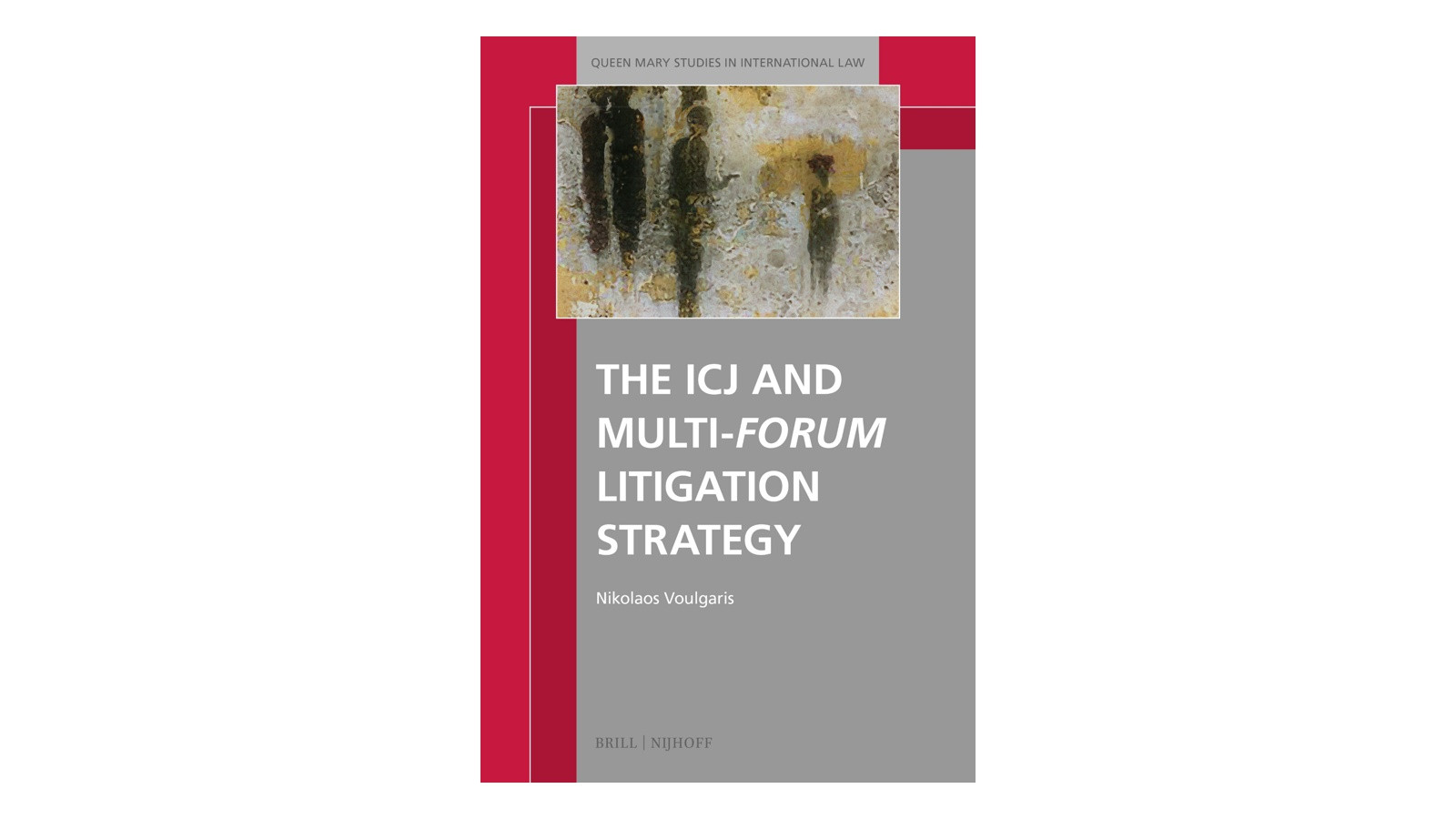
Professor Nikolaos Voulgaris, Professor of International Law at the European Law and Governance University (ELGU), has been awarded the 2026 Monograph Prize of the European Society of International Law (ESIL) for his book The ICJ and Multi-forum Litigation Strategy, published by Brill | Nijhoff in 2025.
The award was presented in September 2026 at the 21st ESIL Annual Conference in Málaga, bringing international recognition to Professor Voulgaris’ research on the changing dynamics of international dispute settlement and the strategic use of international adjudication by States.
The ESIL Monograph Prize is one of the Society’s principal scholarly awards and recognises an outstanding published work making a significant contribution to international legal scholarship. In awarding the 2026 Prize, the Jury (Maurizio Arcari (University of Milano-Bicocca), Cecily Rose (University of Leiden), and María Isabel Torres Cazorla (University of Malaga)) praised The ICJ and Multi-forum Litigation Strategy as an “original and timely contribution” to contemporary international law and highlighted its originality, interdisciplinary depth, strategic insight and extensive engagement with international jurisprudence.
A new framework for understanding international litigation
The book examines the growing practice of States pursuing litigation across multiple international judicial and quasi-judicial fora. It places the International Court of Justice (ICJ) at the centre of this development and asks how States select, combine and use different international proceedings as part of broader litigation strategies.
At the heart of the book is the concept of “multi-forum litigation strategy”, which Professor Voulgaris develops as a distinct analytical framework for understanding contemporary State practice. The Jury particularly recognised the value of this approach, noting that it moves beyond broader concepts such as “lawfare” and “strategic litigation” to identify the specific characteristics of multi-forum litigation involving States.
The book also brings a strategic perspective to the study of international adjudication. It demonstrates that States may resort to international courts not solely to obtain judicial remedies, but also in pursuit of wider diplomatic and political objectives. At the same time, it examines the implications of such strategic uses for the judicial character, authority and legitimacy of international courts.
This perspective offers new insights into the evolving role of the ICJ—not only as a dispute-settlement institution, but also as an important actor within the broader political and diplomatic environment in which contemporary international disputes unfold.
Law, strategy and the changing international judicial landscape
A distinctive feature of the monograph is its interdisciplinary approach. Combining detailed legal analysis with insights from international relations, the book argues that contemporary international litigation cannot be fully understood through legal doctrine alone.
The analysis proceeds from the conceptual foundations of multi-forum litigation strategy to the different forms of engagement with the ICJ, including contentious proceedings, requests for provisional measures and advisory opinions. This structure enables the book to explore questions of jurisdiction, procedure, State strategy and institutional authority within a unified analytical framework.
The Jury also highlighted Professor Voulgaris’ extensive and rigorous examination of international jurisprudence. The book draws on a wide range of contemporary disputes and proceedings, including cases involving Ukraine and Russia, Qatar and the United Arab Emirates, Mauritius and the United Kingdom, Armenia and Azerbaijan, South Africa and Israel, and The Gambia and Myanmar.
These proceedings serve not merely as illustrations of individual legal questions, but as the basis for broader conclusions about the possibilities and constraints of international adjudication and the ways in which States strategically engage with international courts.
The book’s analysis ultimately raises important questions about the future authority and jurisdiction of the ICJ. By examining how States engage, test and frame the Court’s jurisdiction in the context of wider litigation strategies, it contributes to a deeper understanding of the Court’s changing position within the international legal order.
In its final assessment, the ESIL Jury concluded that The ICJ and Multi-forum Litigation Strategy “represents a major contribution to international dispute settlement scholarship” and accordingly awarded it the 2026 ESIL Monograph Prize.
EPLO and ELGU congratulate Professor Nikolaos Voulgaris on this distinguished recognition of his scholarship and on the contribution that his work makes to the study of international adjudication and the evolving international legal order.