
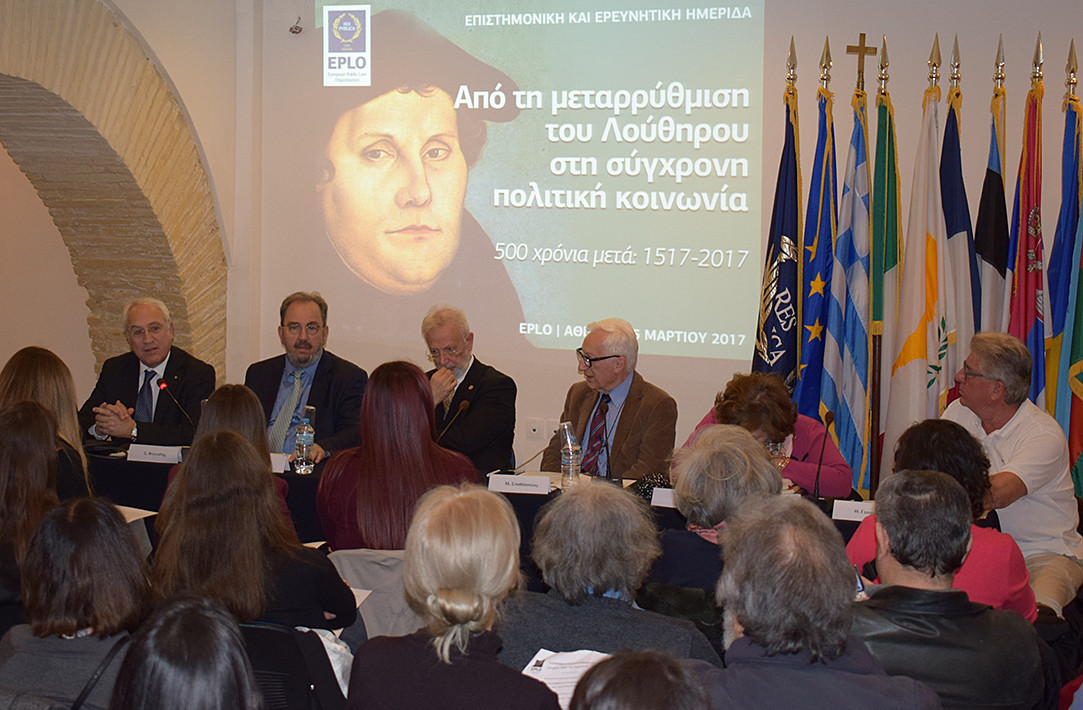
The reforms of Martin Luther that followed his encounter with the Catholic Church did not only affect the religious influence in Europe. To a large extent they changed the course of history by giving way to the creation of nations but also to the establishment of institutional law. The position of Luther against the Peasants' War of 1524 for which he suffered strong criticism does not diminish his contribution to the progress of humanity.
This was the conclusion of the debate among six academics, along with wide public participation, on Wednesday March 15, 2017, in the Conference Hall of the European Public Law Organization (EPLO) in Plaka, Athens.
The scientific and research workshop entitled "From Luther's reform in modern political society" was organized by the EPLO to mark the 500 years since 1517 when Luther nailed his Ninety-five Theses at the door of All Saints' Church in Wittenberg which constituted a direct attack on the Papacy.
Coordinator of the workshop was Michalis Stathopoulos, member of the Academy and Honorary Professor of the National and Kapodistrian University of Athens. The speakers were:
■ Spyridon Flogaitis, Professor of public law at the National and Kapodistrian University of Athens, Director of the EPLO.
■ Ismini Kriari, Rector of Panteion University of Social and Political Sciences, Professor of constitutional law at the same university.
■ Constantinos Delikostantis, Emeritus Professor of the Theological School of the National and Kapodistrian University of Athens.
■ Charis Meletiadis, Professor of history, Panteion University of Social and Political Sciences.
■ Theodoros Georghiou, Professor of political philosophy of Democritus University of Thrace.