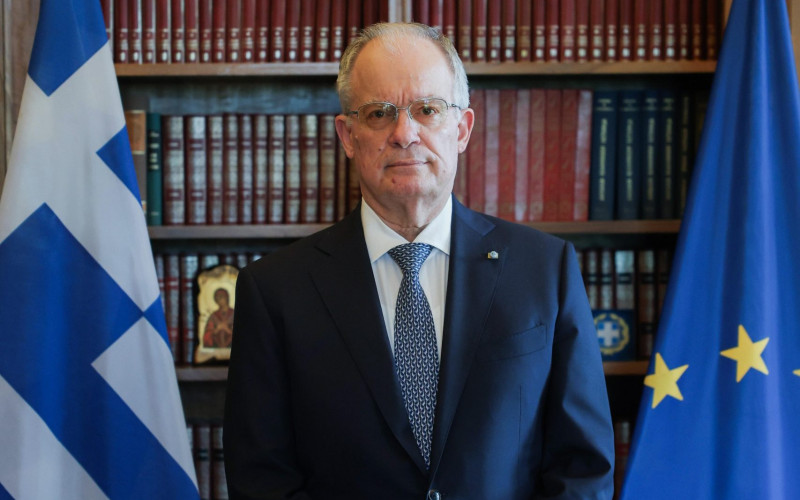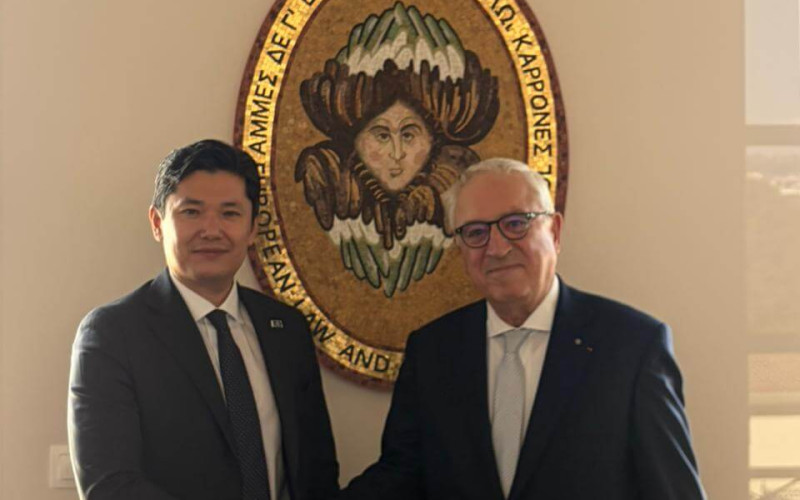
The German former Chancellor Mr Helmut Schmidt was proclaimed Honorary Doctor of the University of Athens by a University delegation headed by Rector Prof. Theodoros Fortsakis, at a special ceremony held at the City Hall of Hamburg.
The former chancellor was honored for his contribution as "with his actions and signature, he brought Greece back to the boundaries of its spiritual creature, Europe", Mr. Spyridon I. Flogaitis, Professor of Law at the University of Athens, mentioned. Prof. Flogaitis referred to the historical background of Europe, from its inception during the Roman Empire, its separation into East and West- which placed Greece in the East- up to the 1821 revolution and the return of Greece within Europe.
However, he particularly focused in the modern times when "Chancellor Helmut Schmitt decided without hesitation to support the accession of Greece to the European Community". Mr Flogaitis added that Mr Schmitt reinstated ideologically Greece within the West "giving back its neglected honor, stating that the West did not forget its homeland, reversing a trend of history that had been initiated by the innocent administrative action of dividing the Roman Empire into east and west ".
"This action recorded Chancellor Helmut Schmitt into the history of Europe and the hearts of the Greeks, this emotional people who does not forget its benefactors. And due to this fact, the Law School of the University of Athens, the first institution in the country, founded by a German king who became Greek, and played a central role in the development of the Greek nation, decided to declare Honorary Doctorate for outstanding contribution to the Nation, the man who with his signature and actions, brought Greece back to Europe, its spiritual creature" concluded Mr. Flogaitis.
Former Chancellor thanked for the honor given to him and noted in particular that considers the title as a symbol of Greek-German cooperation. He also referred to his stance on European issues over time, from the late 40s until today. "I was and remain a supporter of the idea of European integration and of Germany's participation in Europe", underlined, while referring to today, stressed the "lack of a common fiscal policy, a common economic policy, a common social policy."
He concluded, recognizing the difficulties faced by the Greeks during recent years, but noted that "Greece has gone into a successful path. I fervently wish to the Greek neighbors and partners success"