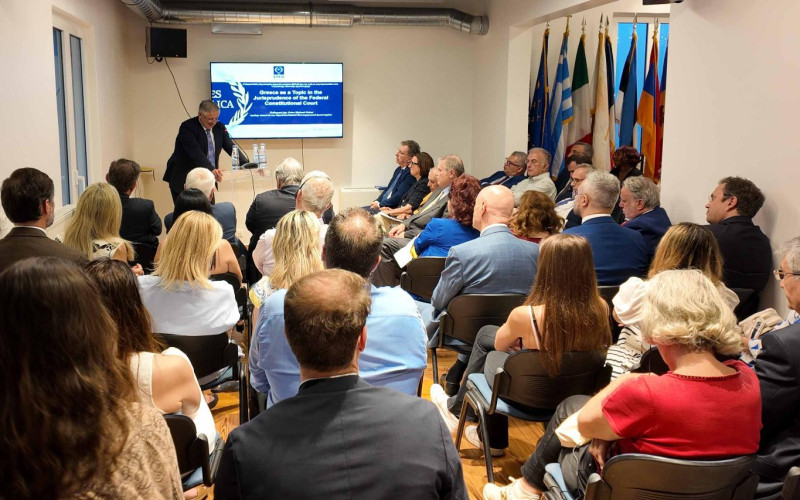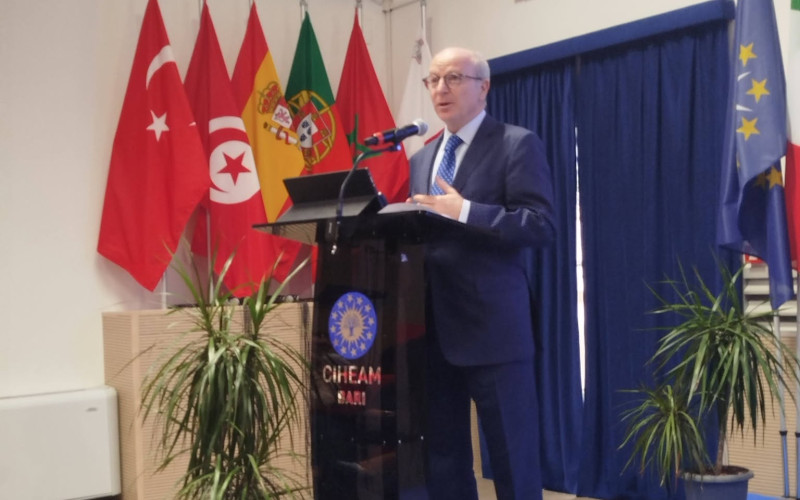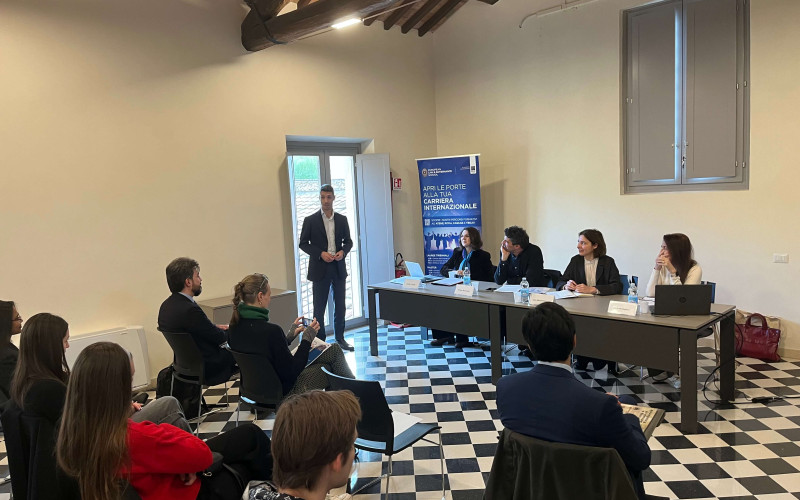
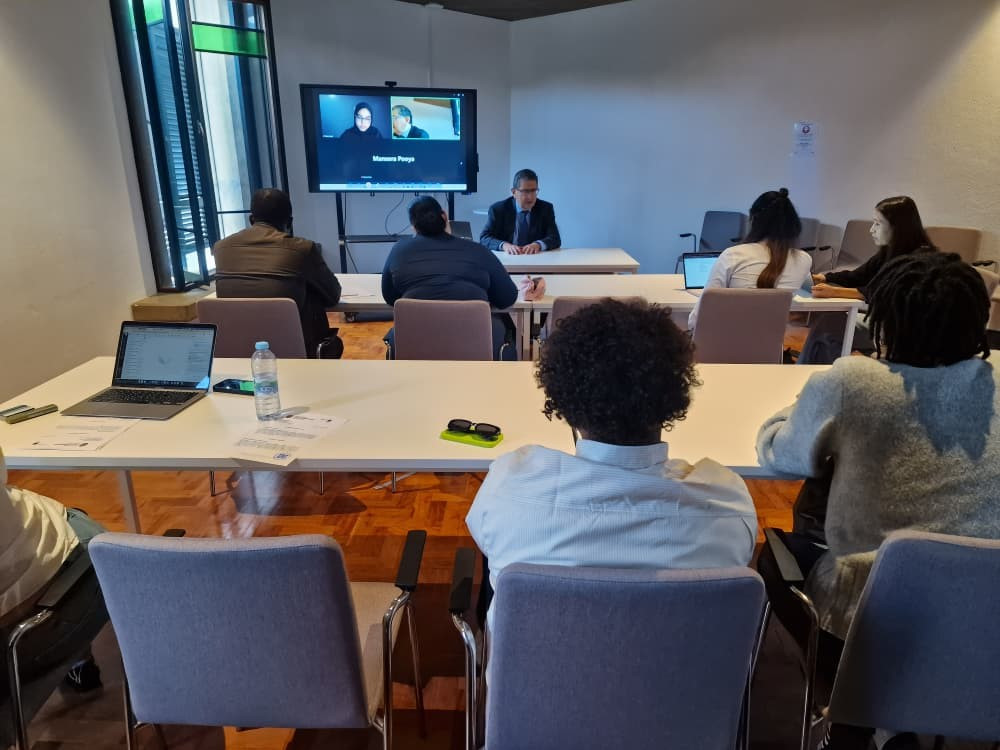
On 16 November 2026, Ambassador Ioannis Metaxas, Director of EPLO’s Regional Branch in Portugal and former Ambassador of Greece to Portugal, delivered a guest lecture to students of the European Law and Governance University (ELGU) in Cascais, focusing on the history of public law and the development of the European Public Law Organization (EPLO).
The lecture offered students an introduction to the foundations and evolution of public law, tracing its development from ancient civilizations to modern democratic institutions. Ambassador Metaxas began by explaining the distinction between private law, which regulates relations between individuals on an equal footing, and public law, which governs the relationship between the state and its citizens. He highlighted the importance of understanding this distinction, particularly for students coming from common law backgrounds.
Taking students through different periods of history, he contrasted the systems of governance of ancient Egypt, where rules were established by the king, with the emergence of lawmaking through popular assemblies in ancient Greece. He also discussed the continuation of representative political institutions in Republican Rome, including the Senate, and the gradual development of modern democratic systems in which laws are adopted by elected parliaments.
Ambassador Metaxas went on to outline the principal fields of public law: constitutional law, administrative law, the organisation of justice, European Union law and public international law. He stressed that these are not merely academic disciplines, but fundamental components of democratic governance. As he explained, democracy cannot exist without rules, an independent system of justice and equality before the law.
The lecture also highlighted the international reach of public law, with Ambassador Metaxas noting that European Union legislation, including rules governing the automotive industry and environmental protection, can have an impact well beyond the Union’s borders.
Turning to the EPLO, under whose auspices ELGU operates, he presented the Organization’s origins, mission and international outlook. Although European in name, EPLO has an international scope and works to promote the traditions of public law, the rule of law and democracy through its activities and cooperation with countries and institutions around the world.
The presentation was followed by a discussion during which students raised questions about EPLO’s history, the requirements for membership in the Organization and the challenges facing democracy today. Ambassador Metaxas explained that EPLO emerged from an academic network of public law professors in Greece and that membership is open to democratic countries.
He also reflected on the responsibilities involved in sustaining democratic institutions, underlining that democracy requires continuous commitment and protection. He highlighted the importance of independent justice and gender equality, while emphasising that there is no single model of democracy that can or should be imposed on every country. Rather, each society must find its own path, shaped by its history and experience.
The lecture provided ELGU students with an opportunity to connect the historical development of public law with the institutions and democratic challenges of the present, while gaining a deeper understanding of the ideas and international mission underpinning EPLO.