
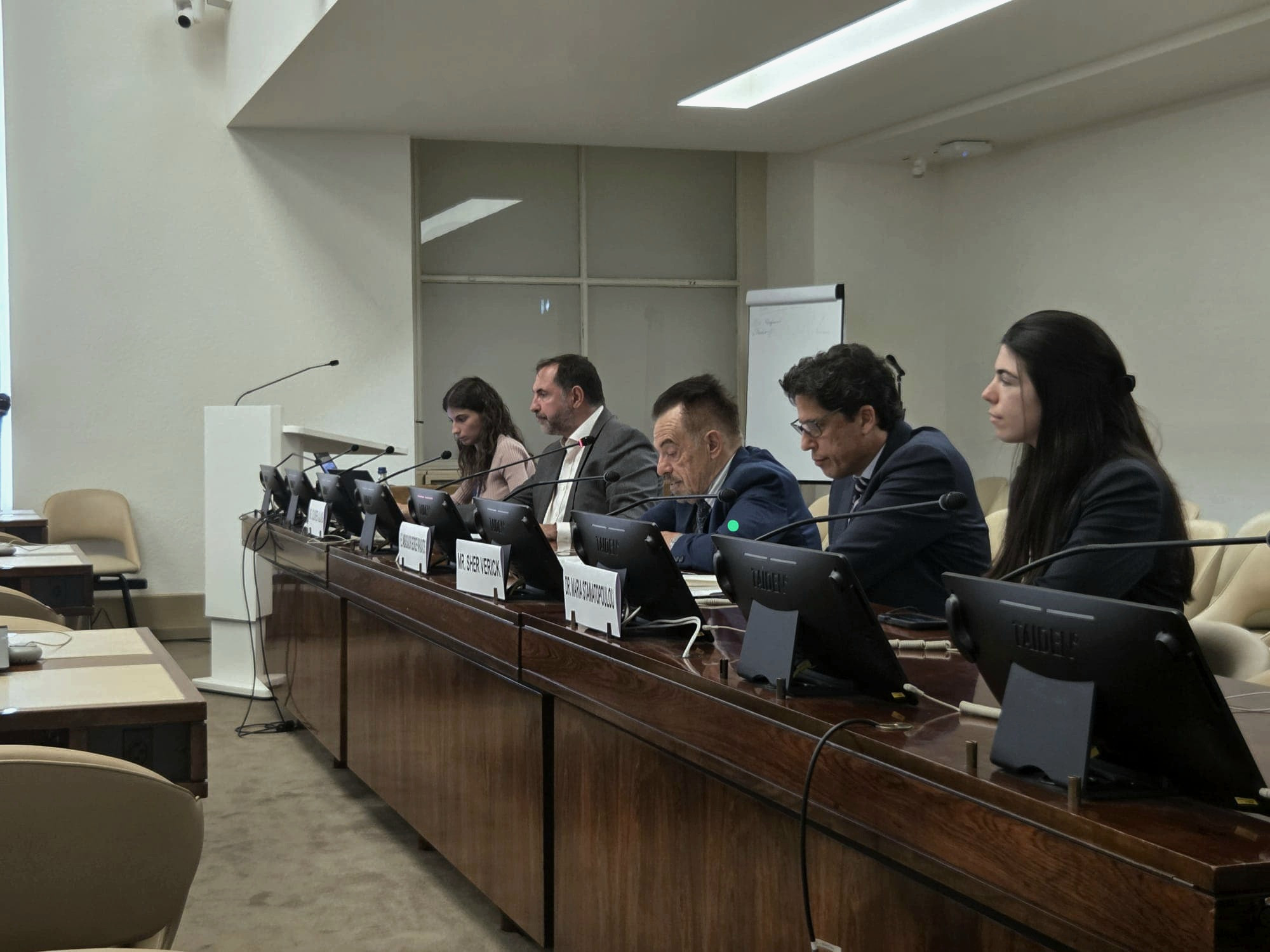
The European Public Law Organization (EPLO) reinforced its engagement with the international human rights community during the 63rd Session of the United Nations Human Rights Council (HRC63), held in Geneva between 22 September and 2 October 2026. Through a series of high-level events, expert interventions, and public outreach initiatives, EPLO contributed to key discussions on international law, artificial intelligence, multilateral diplomacy, good governance, and non-violence.
Representing EPLO in Geneva, Ambassador George Papadatos, Permanent Observer to the United Nations and other international organizations in Geneva, participated in and convened discussions that brought together diplomats, international organizations, academic experts, and civil society representatives. These engagements highlighted EPLO's commitment to advancing effective multilateral cooperation and strengthening public law and governance frameworks in addressing contemporary global challenges.
Strengthening International Law Through Greater Institutional Cooperation
On 22 September, EPLO organized a discussion at the Geneva Press Club entitled "Strengthening International Law through Greater Cooperation between the Human Rights Council and the UN General Assembly Fourth Committee." Moderated by Ambassador Papadatos, the event explored pathways for bridging the gap between Geneva-based human rights mechanisms and the political and decolonization work undertaken in New York. Participants examined how findings emerging from the Human Rights Council could better inform broader UN deliberations and contribute to more coherent international responses to complex global challenges.
Artificial Intelligence and Good Governance
On 23 September, Ambassador Papadatos was invited to speak at the side event "Artificial Intelligence for Good Governance: Opportunities and Risks," organized by the Permanent Mission of Poland on behalf of the cross-regional core group on good governance, comprising Australia, Chile, Poland, the Republic of Korea, and South Africa.
Addressing an audience of approximately 70 participants at the Palais des Nations, Ambassador Papadatos focused on the potential of artificial intelligence to support anti-corruption efforts, particularly through the identification of suspicious patterns and the assessment of the economic and human rights costs of corruption. He emphasized that AI should complement, rather than replace, independent human investigation and called for further international cooperation in developing robust methodologies for measuring corruption-related impacts.
Exploring the Role of AI in Human Rights and Diplomacy
Continuing its focus on emerging technologies, EPLO convened a dedicated side event on 28 September at the Palais des Nations entitled "The Role of AI in Advancing Human Rights and Multilateral Diplomacy."
Moderated by Ambassador Papadatos, the discussion introduced the concept of the "last mile of diplomacy," examining how artificial intelligence could assist negotiators in identifying areas of convergence, evaluating trade-offs, and exploring potential settlements when conventional negotiations reach deadlock, while preserving human responsibility and legal safeguards.
The panel featured distinguished experts including Sher Singh Verick of the International Labour Organization (ILO), Olivier Alais of the International Telecommunication Union (ITU), and Dr. Maria Stamatopoulou of Laelaps AI. Attended by approximately 50 participants, including representatives of diplomatic missions and international organizations, the event generated a lively discussion on algorithmic bias, accountability, transparency, and the enduring importance of human relationships in diplomacy.
Marking the International Day of Non-Violence
On 2 October, Ambassador Papadatos participated as a speaker in the celebration of the International Day of Non-Violence, organized by the Permanent Observer of the University for Peace and co-sponsored by Interfaith International.
The event underscored the importance of peaceful dialogue, tolerance, and non-violent approaches to conflict resolution, complementing EPLO's broader engagement during the Human Rights Council session and expanding its contribution to Geneva's peace and human rights dialogue.
Promoting Public Debate Beyond the Council
EPLO's activities during HRC63 also received wider international visibility through coverage in The Diplomatic Affairs. Discussions held at the Geneva Press Club were featured in the publication's article "EPLO is Debating: Can International Law Still Speak with One Voice?" while Ambassador Papadatos further contributed to public debate through his article "Beyond UN Reform: An Independent Commission to Reimagine Multilateralism."
The article advances proposals for institutional renewal within the multilateral system and explores how artificial intelligence can enhance analysis and participation in global governance processes while ensuring that decision-making authority remains firmly in human hands.
Advancing EPLO's Mission in Geneva
Through these initiatives, EPLO demonstrated its capacity to convene meaningful dialogue, contribute expertise to international policy discussions, and promote innovative approaches to contemporary governance challenges. Discussions on artificial intelligence generated practical exchanges on safeguards and future applications, while broader conversations on international law, institutional coherence, human rights, and peaceful cooperation reinforced EPLO's longstanding commitment to the rule of law and effective multilateralism.
The Geneva Office's active participation in HRC63 further strengthens EPLO's profile within the United Nations system and highlights its growing role as a platform for dialogue on some of the most pressing issues facing the international community today.