
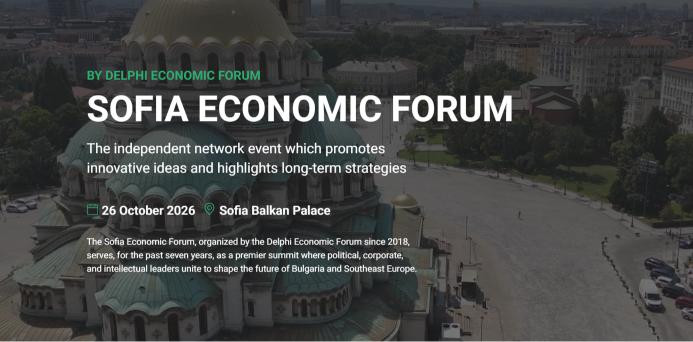
The Sofia Economic Forum VII, held on 26 October 2026 in Sofia, brought together senior government officials, policymakers, business leaders and international experts to discuss the economic outlook of Bulgaria, regional cooperation, European integration, energy security, connectivity, artificial intelligence and geopolitical developments in Southeast Europe.
The European Public Law Organization (EPLO) was represented by George Kremlis, Ambassador of the European Public Law Organisation to Bulgaria, Honorary Director of the European Commission, Member of the Board of Directors of EPLO, and Director of its Climate and Circular Economy Institute.
During the Forum, George Kremlis chaired and contributed to discussions on two key themes of strategic importance for Southeast Europe:“Hardwiring the Region: Strategic Infrastructure and Connectivity in Southeast Europe” and “Circular Economy as the New Economic Driver.” These sessions focused respectively on strengthening regional infrastructure and cross-border connectivity, as well as advancing sustainable economic models based on resource efficiency, innovation and circular economy principles.
The Forum's agenda addressed a broad range of issues shaping the future of the region, including Bulgaria's first year in the Eurozone, public-private partnerships, demographic challenges, energy resilience, artificial intelligence, transatlantic relations and the evolving geopolitical environment in Europe and the Black Sea region.
EPLO's participation reflects the Organisation's continued engagement in high-level regional dialogue on sustainable development, governance, climate policy, economic transformation and European cooperation. Through its academic, policy and institutional initiatives, EPLO remains committed to fostering informed discussion and practical solutions to the challenges facing Europe and its neighbouring regions.
As a longstanding advocate for circular economy and environmental governance, George Kremlis highlighted the importance of integrating sustainability into economic planning and regional development strategies, reinforcing the need for cooperation between public institutions, the private sector and international organisations in addressing common challenges.